Team member project / Video and AI
Content-Factory.Art: from idea to publication
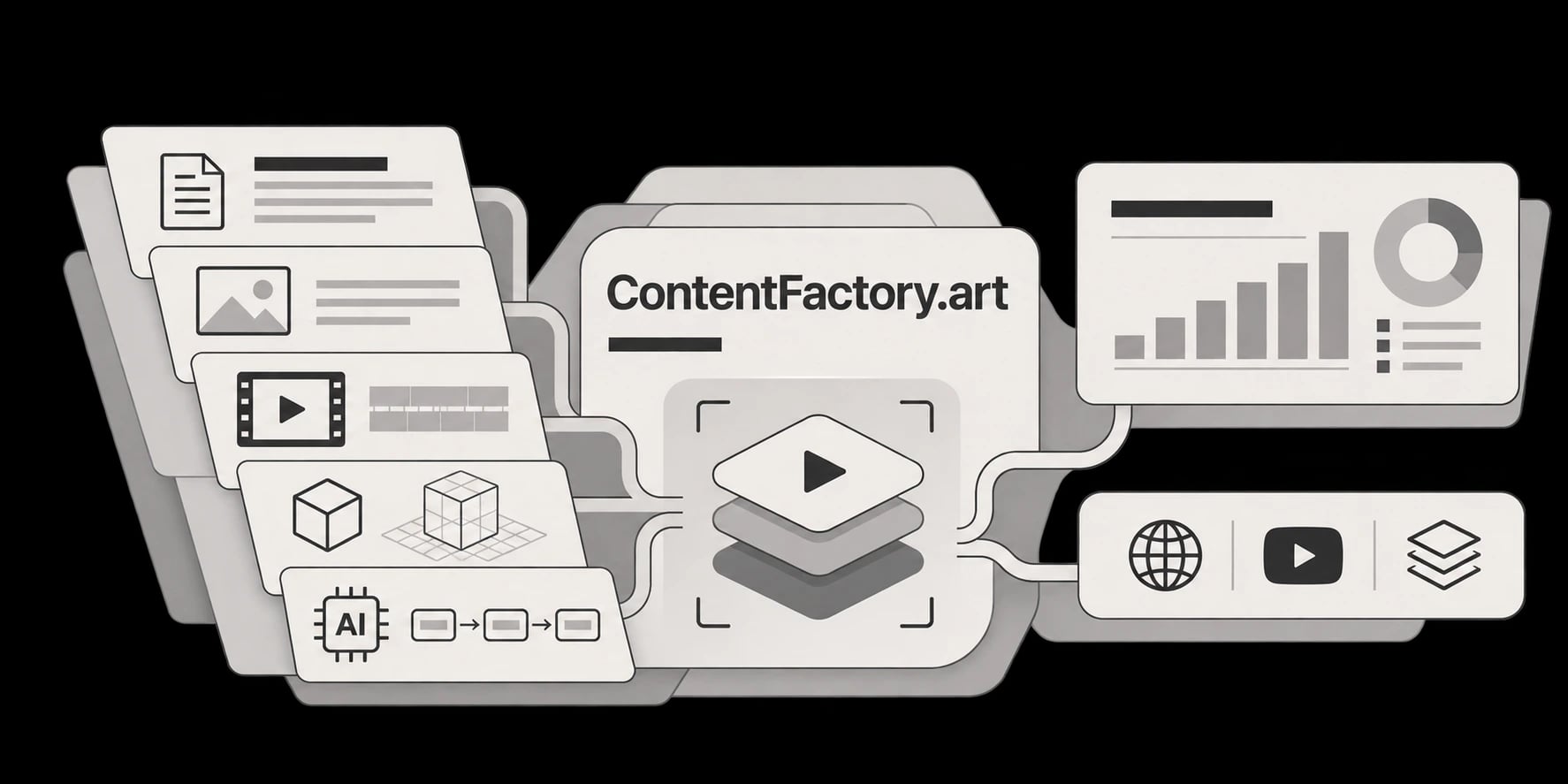
Content-Factory.Art is independently developed by one of our team members. It brings content creation, AI tools, editing, scheduled publishing and performance analytics into one workspace.
01 / Where it started
Finishing the video is not the end of the job
Producing a short video often means collecting a script, images, footage and voiceover. Some assets come from generators, others go through editors, and everything eventually has to reach the timeline. When a change is needed, someone must track down the right source and the latest version.
When content goes out regularly, editing is only one part of the work. Someone still has to publish it across channels, keep to a schedule and see how each post performs. Separate tools mean more file transfers, repeated steps and time spent collecting statistics.
Content-Factory.Art began as a personal project by one of our team members, who continues to develop it independently. The idea is to keep assets and their production history within a project, with AI handling defined operations.
Sources and edits are scattered across tools. Scheduling and checking publication results happen elsewhere.
Prepare content, edit it, arrange automatic publishing and follow the results within one project.
02 / What we did
From source files to publishing
Images, footage, sound and documents belong to a project alongside processed assets and versions. The team can return to earlier material without piecing together its history from folders and messages.
Production tools cover media generation and processing, layered compositions, effects, subtitles, previews and rendering. Existing content can also become part of the edit: presentation slides or a capture of a public webpage, for example.
Creators can connect their own AI agent, such as Codex or Claude Code, to help with defined operations. A person reviews the materials and approves the final version.
After the content is ready, users can set up automatic publishing to connected platforms and choose when posts should go live. Publishing statistics and performance metrics are available in the workspace, helping creators and marketers understand what worked and what to make next.
What makes the work easier
Less switching between services
Source files, revisions, final videos and publications stay with the project. There is less time spent finding the right asset and passing it to another tool.
Use the AI agent you already have
Connect Codex or Claude Code with your existing subscription. For frequent use this may cost less than per-token API billing. Generation, processing and rendering are billed separately.
Know what happens after publishing
Schedule posts on connected platforms and review their results. Marketers can see which content is worth building on and which ideas need reworking.
03 / Explore the work
From creation to publishing
CONTENT-FACTORY.ART / Content workflow
Open examples and editorsCreate
Idea, sources, AI tools
Edit
Video, sound, final cut
Auto-publish
Platforms and schedule
Analytics
Publication results
04 / What changed
Less admin work when content goes out regularly
Producing a series of videos involves more than editing. Assets need to stay accessible, changes must be tracked, posts need scheduling and results need reviewing. Content-Factory.Art keeps these steps together so the workflow does not have to be rebuilt for every release.
That matters to creators, marketers and small teams publishing frequently. The product is still evolving. We do not present unmeasured time savings as established results.
ACG / LET'S TALK
Are creation, publishing and analytics split across tools?
Tell us how you create and distribute content today. We'll look at what belongs in one workflow and which repetitive steps could be automated.